Fig wasps
Fig wasps
(Life: Kingdom: Metazoa (animals); Phylum: Arthropoda; Class: Hexapoda; Order: Hymenoptera; Superfamily: Chalcidoidea)
Back to Ficus home page Back to figs and fig wasp home page
| |
To find out which groups of wasps are associated with fig trees and to explore their classification click on the above link. |
|---|

 | How many species of fig wasp are there?
To learn more about fig wasp diversity click on the above link. |
|---|
| |
To learn more about the biology of fig wasps click on the above link. |
|---|

|
| Fig wasp checklists and local faunas
Follow this link to find out which fig wasps occur in specific areas. |
|---|

| |
To access the published literature on fig wasps and fig trees click on the above link.
|
|---|

Web page development and text by Simon van Noort (Iziko South African Museum) and Jean-Yves Rasplus (INRA, France)
Copyright 2005 Iziko Museums of Cape Town
Who are fig wasps?
(Life: Kingdom: Metazoa (animals); Phylum: Arthropoda; Class: Hexapoda; Order: Hymenoptera; Superfamily: Chalcidoidea)
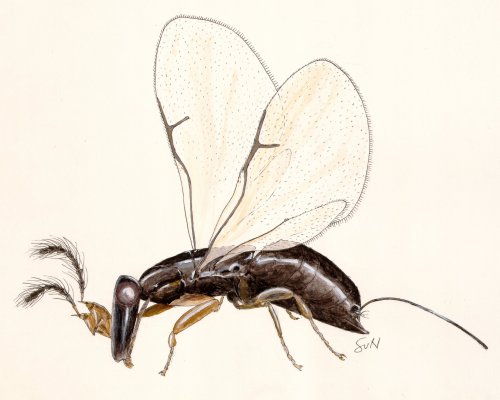
| Illustration © Simon van Noort | Illustration © Simon van Noort | Photo Simon van Noort © Natural History Museum London |
| Photo © Jean-Yves Rasplus | Photo © Jean-Yves Rasplus | Photo © Simon van Noort (Iziko)
|
| |
|


"Fig wasp" is a broad term applied to chalcid wasps (Chalcidoidea, Hymenoptera) that exclusively breed in figs, the enclosed inflorescence of fig trees (Ficus, Moraceae), but excludes those chalcids that are parasitoids of facultative utilizers (such as lepidopteran, coleopteran and dipteran larvae) of the fig niche. From a taxonomic perspective the term "fig wasp" encompasses representatives of five chalcid families (Agaonidae, Pteromalidae, Ormyridae, Eurytomidae and Torymidae) making up the assemblage of chalcidoid wasps associated with figs. All species in the family Agaonidae breed in figs, but the Pteromalidae, Ormyridae, Eurytomidae and Torymidae only have a very small proportion of their total species associated with figs.
Fig wasps were previously all united under the Agaonidae incorporating six distinct taxa at subfamily level (Epichrysomallinae, Otitesellinae, Sycoryctinae, Sycoecinae and Sycophaginae) (Bouček 1988). Subsequent morphological and molecular studies indicated that the Agaonidae as defined by Bouček was not monophyletic (Machado et al. 1996; Kerdelhué 1997; Rasplus et al. 1998). Recent molecular investigations of DNA sequences showed that the different groups of fig wasps are not closely related, suggesting that the fig niche has been colonised on a number of separate occasions by different wasp lineages over evolutionary time. The precise classificatory position of these groups of non-pollinators is currently under investigation through both morphological and molecular appraisals of their evolutionary relationships. The Sycoecinae, Otitesellinae and Sycoryctinae have been reassigned to the Pteromalidae, leaving only the pollinating fig wasps in the Agaonidae (Rasplus et al. 1998; Campbell et al. 2000). Phylogenetic relationships of the remaining two subfamilies (Sycophaginae and Epichrysomallinae) are still unresolved, but they do not belong in the Agaonidae.
From an ecological perspective most fig wasp species are phytophagous and the remaining species are inquilines or parasitoids of these gallers. The phytophagous species gall the ovule to provide a food resource for larval development. The relationship of the pollinating fig wasps with their host fig tree is an obligate mutualism: the tree relies on the wasps for pollen dispersal and pollination, and in turn the wasps can only reproduce in the florets within the fig.
Biology of the interaction between fig wasps and fig trees
Fig wasp diversity
(Life: Kingdom: Metazoa (animals); Phylum: Arthropoda; Class: Hexapoda; Order: Hymenoptera; Superfamily: Chalcidoidea)
Fig wasps are circumtropical in distribution, with about 640 described species in the world. This figure probably represents about 20-30% of the existing species - in other words we still have to describe (and in many cases still collect) another 1300 to 2600 species!
There are 228 described species of an estimated 700-1000 species in the Afrotropical region (an estimation based on available undescribed material, host-specificity and extrapolation from host associations). The pollinators (Agaonidae) are known from about 70% of the 105 African Ficus species listed by Berg (1990), (Wiebes & Compton, 1990), while 56% of the African Sycoecinae have also been described, as estimated from an extrapolation of known host associations (van Noort, 1994). In the Neotropical region there are 122 described species and in the Indo-Australasian region there are around 290 described species.
Berg & Wiebes' book on African fig trees and fig wasps (1992) forms the foundation for our taxonomic knowledge of fig wasps from the Afrotropical region, but as with any systematic treatise where work is ongoing this book was out of date almost as soon as it was published. Systematics of fig wasps is currently being worked on by a number of researchers. Jean-Yves Rasplus and Carole Kerdelhué are revising the Epichrysomallinae and Sycophaginae. Simon van Noort has completed the revision of the Afrotropical Sycoecinae (although more undescribed material has already become available), and, in collaboration with Jean-Yves Rasplus, is currently revising the Indo-Australasian Sycoecinae, world Otitesellinae and Afrotropical Agaonidae.
The following tables provide data on described and estimated species richness (based on extrapolation from known host associations) for three groups of fig wasps (data from van Noort & Rasplus in prep).
Interaction of figs and fig wasps
(Life; Embryophyta (plants); Angiospermae (flowering plants); Eudicotyledons; Order: Rosales; Family: Moraceae; Genus: Ficus)
|
Ficus tremula tremula Illustration © Simon van Noort |
Courtella wardi Illustration © Simon van Noort |
Apocrypta quineensis ovipositing through the fig wall of Ficus sur Photo © Simon van Noort (Iziko) |


-
Who pollinates fig trees?
-
How are fig trees pollinated?
-
Life cycle of the mutualism
-
Non-pollinating fig wasps
-
How is the mutualism maintained?
-
Video of the interaction
-
Back to figs and fig wasp home page
-
Back to fig wasp home page
---
posted by hdc at 7:58 PM

0 Comments:
Post a Comment
<< Home